2026 Turkish Dried Fig Crop: Quick Answer
As of 30 August 2026, the new Turkish dried fig crop looks larger and healthier than last season. Harvesting and natural sun-drying are under way in Aydin, and the first arrivals show good color and encouraging fruit quality. An industry yield study sees potential for production to reach 95,000 metric tons, but that figure remains conditional on dry, stable weather through the rest of the drying period.
For importers, the opportunity is better availability. The main caution is that exportable supply will depend not only on the crop size, but also on final grading, moisture, defect levels and strict aflatoxin and ochratoxin controls.
Executive Summary
- The 2026/27 dried-fig harvest is under way in Aydin, Türkiye’s principal producing region. The Aydin Commodity Exchange held its first-purchase ceremony on 26 August 2026. The TRY 850/kg transaction was ceremonial and should not be treated as a commercial market benchmark.
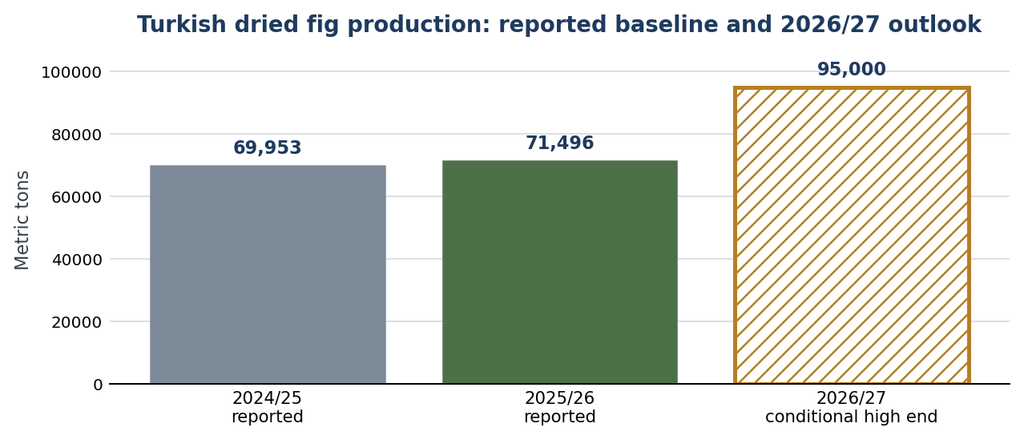
- Reported Turkish dried-fig production in 2025/26 was 71,496 metric tons, including 57,716 metric tons from Aydin. Turkey exported 52,440 metric tons during the same season.
- An industry yield study indicates that 2026/27 output could reach 95,000 metric tons if favorable weather continues through the drying period. This is a conditional high-end estimate, not a final official crop figure.
- Early arrivals are described as having attractive color and very good quality. A mild winter and generally favorable orchard development supported good sizing and healthy fruit before harvest.
- Availability should improve compared with 2025/26 if the crop develops as expected. Nevertheless, tight old-crop availability, high opening farm-gate expectations and premiums for large, clean, compliant fruit may keep early export offers firm.
- Aflatoxin and ochratoxin management is the season’s leading quality-risk issue. Supplier selection, field hygiene, careful defect removal, UV sorting, lot-specific laboratory testing and traceability remain essential.
Season Snapshot
| Indicator | 2024/25 | 2025/26 | 2026/27 preliminary outlook |
| Turkish dried-fig production | 69,953 mt | 71,496 mt | Up to 95,000 mt – conditional industry high end |
| Aydin production | 54,085 mt | 57,716 mt | Official regional figure not yet published |
| Turkish dried-fig exports | 57,320 mt | 52,440 mt | New-season export program not yet started |
| Producer-market reference | Not used here | TRY 233.82/kg average producer sale | TRY 850/kg first lot was ceremonial; normal price discovery is pending |
1. 2026 Turkish Dried Fig Harvest Progress
Regional concentration
Aydin is still the heart of the Turkish dried fig industry. In 2025/26, the province supplied approximately 80.7% of reported national production. Orchards are concentrated across the Büyük Menderes valley and nearby districts, where the pale-yellow Sarilop fig is the main variety used for drying. Aydin İnciri is also recognized among Türkiye’s EU-registered geographical indications.
Weather and orchard conditions
The season began with a mild winter, which helped the orchards develop evenly. By late June, field reports were already pointing to healthy fruit and good sizing. A short spell of rain reached Aydin in mid-August, but it cleared quickly and no lasting crop damage was reported. The first dried figs later arriving in the market were described as having good color and very good quality.
| Weather sensitivity: The outlook remains provisional. Rainfall or extended humidity during natural drying can reduce pack-out, increase cracking or souring, darken color and raise the risk of mold and mycotoxin formation. |
Harvest calendar
| Period | Typical activity | 2026/27 status |
| Late July-August | Maturity, natural fruit drop and first collections | Harvest started; favorable early observations |
| August-September | Sun drying, repeated collection and primary sorting | Current critical window; weather remains decisive |
| September | Bulk arrivals, grading, sampling and commercial price discovery | Expected to intensify as volumes build |
| September-October | Processing, final packing and export loading | Official first-loading date had not been announced as of this report date |
2. New Crop Turkish Dried Fig Quality Outlook
Early positive indicators
- Color: early dried figs are reported as visually attractive, an encouraging sign for natural and shaped presentations.
- Fruit condition: early reports indicate healthy fruit and good development before harvest.
- Sizing: pre-harvest observations were positive, but the final count-size distribution cannot be confirmed until bulk arrivals are graded.
- Moisture: the Sarilop variety is commonly associated with approximately 22-24% moisture when properly dried; each contract should state its own maximum and test method.
Quality variables still to be confirmed
The first lots do not necessarily represent the full crop. Commercial quality will be determined by the final distribution of count sizes, color, skin integrity, internal condition, moisture, infestation status, foreign matter and the proportion of defective fruit. Buyers should therefore base approvals on representative production lots rather than ceremonial or very early samples.
3. Food Safety and Compliance Priorities
At the 2026/27 pre-season sector meeting, aflatoxin and ochratoxin were identified as the most important trade and quality-control concern. Cracked, damaged or poorly handled fruit requires especially careful removal because defects can elevate fungal and mycotoxin risk.
A peer-reviewed study published in 2026, using export-company samples collected during 2024 and 2025, likewise reinforces the need for continuous screening. Those historical results should not be interpreted as a finding about the 2026 crop.
Recommended control chain
- Field and drying hygiene: Frequent collection, clean raised drying surfaces, rapid moisture reduction and protection from unexpected rain or evening humidity.
- Defect removal: Separate cracked, sour, moldy, insect-damaged, dark or otherwise suspect fruit before processing.
- Optical and UV sorting: Use validated sorting systems and trained personnel to remove fluorescent or otherwise non-conforming fruit.
- Lot-specific testing: Obtain accredited laboratory results for aflatoxin B1, total aflatoxins and ochratoxin A, together with moisture and other destination-specific tests.
- Traceability: Maintain orchard/collector, intake, processing, laboratory, packing and shipment records for each lot.
- Storage and transport: Use clean, dry, pest-controlled facilities and manage temperature and humidity to prevent post-process deterioration.
| Buyer safeguard: Contracts should identify the applicable legal limits, sampling plan, laboratory method, rejection procedure and responsibility for re-testing. Requirements vary by destination and customer. |
4. Turkish Dried Fig Supply and Market Outlook
Availability
If the weather remains favorable, the 2026/27 Turkish dried fig crop should offer noticeably better availability than last season. The high-end estimate of 95,000 metric tons would be well above the 71,496 metric tons reported for 2025/26. Even so, a large harvest does not automatically mean an equally large export supply. Final availability will be shaped by grade, defects, mycotoxin compliance, domestic demand and the amount of fruit that meets each buyer’s specification.
Pricing direction
The new season opened with a symbolic first purchase at TRY 850/kg on 26 August. This ceremony rewards the earliest producers and is not a representative reference for normal commercial lots. Early export pricing is expected to remain firm while the market evaluates bulk arrivals, size distribution, quality and replacement cost. A larger crop may ease quantity pressure later, but high-grade, large-size, organic and tightly specified low-defect lots can retain meaningful premiums.
Scenario view
| Scenario | Crop/quality effect | Commercial implication |
| Favorable drying weather | Crop moves toward the upper end of current industry expectations; stronger clean-fruit pack-out | Improved availability and broader size selection; price discovery may become more balanced |
| Normal seasonal variability | Good crop but below the conditional high end; mixed regional pack-out | Firm pricing for preferred sizes and qualities; selective opportunities in standard grades |
| Rain or extended humidity | Higher cracking, souring, darkening and mycotoxin-control pressure | Lower exportable yield, stricter selection and stronger premiums for compliant fruit |
5. Recommendations for Buyers
- Approve representative samples: Request samples from stabilized commercial lots after meaningful bulk arrivals, not only from the first harvested fruit.
- Define the specification precisely: State count/size, presentation, color, moisture, defects, microbiological criteria, mycotoxin limits, pesticide requirements and packaging.
- Reserve critical grades early: Large, clean, light-colored, organic and strict-compliance lots may remain limited even in a larger crop.
- Verify certificates and scope: Confirm organic certification, food-safety certification, exporter approval and destination-specific registrations before contracting.
- Require pre-shipment evidence: Use lot-specific certificates of analysis, traceability records and, when appropriate, independent inspection or retained samples.
- Stage purchasing decisions: Balance early coverage for essential volumes with follow-up purchases after the market has clearer information on total pack-out and grade distribution.
Key Takeaway for Importers
| Commercial conclusion: The 2026/27 Turkish dried fig crop begins with a stronger supply outlook and encouraging early quality. Buyers should secure priority grades early, while linking final volume and price decisions to September pack-out, laboratory results and the remaining drying weather. Also Read: Turkish Dried-Fruits Producer with Dedicated Export Operations |
Frequently Asked Questions
When did the 2026 Turkish dried fig harvest start?
Harvesting and natural drying were already under way in August. The Aydin Commodity Exchange held its official first-purchase ceremony on 26 August 2026.
What is the 2026 Turkish dried fig crop estimate?
A current industry yield study indicates potential production of up to 95,000 metric tons if favorable weather continues through the drying period. This is a conditional high-end estimate, not a final official figure.
How does the outlook compare with the previous season?
Türkiye reported 71,496 metric tons of dried fig production in 2025/26. If the 95,000-metric-ton scenario is achieved, the new crop would be roughly one-third larger.
How is the quality of the new crop?
The first arrivals are reported to have good color and very good quality. Pre-harvest observations also pointed to healthy fruit and good sizing, although the final grade and size distribution will only become clear after bulk arrivals.
Is the TRY 850/kg first-purchase price a market price?
No. It was a symbolic price paid for the first lot at the seasonal opening ceremony. Commercial prices will be established through normal market trading as larger volumes arrive.
What is the main food-safety concern for dried fig buyers?
Aflatoxin and ochratoxin remain the main compliance concerns. Buyers should request lot-specific accredited laboratory results, clear traceability and documented sorting controls.
Which Turkish fig variety is mainly used for drying?
Sarilop is the flagship Turkish drying variety, especially in Aydin and the Büyük Menderes valley. It is known for its pale-yellow skin, small seeds and suitability for natural drying.
When should importers place new-crop orders?
Buyers needing large sizes, organic certification, light color or strict low-defect specifications should begin discussions early. Final approvals should be based on representative commercial samples and current laboratory results.