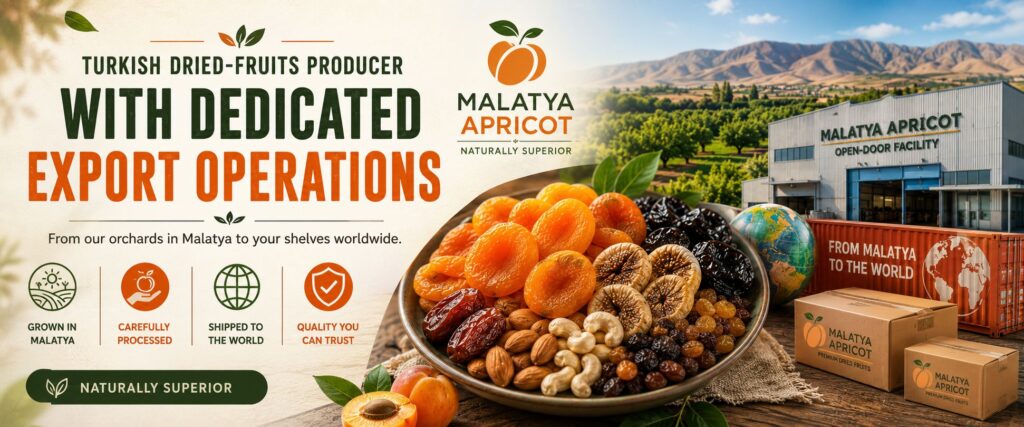
Turkey supplies a large share of the world’s dried fruit, and apricots are at the center of that trade. Yet most shipments still pass through at least one trader before reaching a buyer, which adds cost, delay, and a layer of uncertainty over quality.
A producer that grows, processes, and exports under one roof removes that layer. Documentation, sulfur compliance, packaging, and shipping all get handled by the same team that manages the orchards, which gives buyers a more direct, consistent supply chain.
Export, in this model, is not a secondary function bolted onto a farming operation. It is the foundation the business is built on.
Rooted in Malatya, the World’s Apricot Capital
Around 85% of Turkey’s dried apricot output comes from Malatya province, and that’s exactly where Malatya Apricot is based. The local variety, Hacihaliloglu, has thin skin and high natural sugar. It dries well without much intervention, which is part of why apricots from this region hold their shape and flavor better than fruit grown elsewhere.
A few things make Malatya’s apricots stand out:
- Long, dry summers that cure fruit naturally, with no need for artificial drying methods some regions rely on.
- A variety bred for drying, not just eating fresh, so less fruit is lost to spoilage or cracking,
- Generations of know-how among local farming families on timing, harvest, and post-harvest handling.
- An open-door facility in the Battalgazi district, where buyers and QA teams can walk the sorting lines in person.
That local knowledge shows up in the final product. It’s also why the company can speak with authority about crop quality each season, instead of relying on secondhand reports from a trading desk.
More Than Apricots: Malatya Apricot’s Full Dried-Fruit and Nut Range
Apricots are the anchor product, but the catalog goes well past that. Malatya Apricot supplies:
- Sun-dried, natural, organic, diced, industrial, and conventional dried apricots
- Apricot kernels, both sweet and bitter
- Raisins, dried figs, prunes, and dates
- Almonds and cashews
- Frozen and freeze-dried fruits and vegetables
- Organic dried fruit and vegetable lines
This range matters for buyers who don’t want to juggle five different suppliers for one container. A food manufacturer building a trail mix line, or an importer stocking a health-food shelf, can source most of what they need from one place, with one export contact handling the whole order.
Also Read: Freeze-Dried Fruits vs Fresh Fruits – Which Is Better for Health?
What Happens Before Malatya Apricot Ships a Container
Quality control isn’t a slogan here; it’s a sequence of steps every batch goes through:
- Handpicking during harvest, which runs through August, chosen for ripeness and color rather than speed.
- Sun drying and hand pitting, followed by a second drying stage that gives the fruit its deeper flavor.
- Two rounds of high-pressure washing with fresh water, plus hand inspection to remove foreign material.
- Mechanical sizing, grading fruit from size No.1 through No.8 before packing starts.
- Metal detection on every single batch, no exceptions, regardless of product or pack format.
The processing facility itself is built to European and international food safety standards, with an on-site microbiological lab and anti-bacterial surfaces throughout. Batches get lab-tested before they’re cleared for packing, and again before they leave for export markets.
Malatya Apricot’s Export Operations That Actually Reduce Buyer Risk
Here’s where “dedicated export operations” stops being a marketing phrase and becomes something concrete.
A few examples:
- Sulfur levels adjusted by destination: Generally under 2,000 ppm for European buyers, and 2,500 to 3,000 ppm for the US and other markets, matched to what each region actually allows.
- Full documentation per shipment: Phytosanitary certificates, health certificates, lab reports, and certificates of origin are all prepared without buyers having to chase them down.
- Packaging built for the destination: Standard 5 kg and 12.5 kg cartons cover most wholesale and food-service orders. Retail formats come in 200 gr and 400 gr packs, in plastic, hard plastic, PVC, or thermoform trays. Bulk orders load onto US or Euro pallets, in 20 FCL or 40 FCL containers.
- Private label: Available on request, once artwork and branding are confirmed.
- One dedicated export contact per buyer: Reachable by email, WhatsApp, or phone, with replies typically within one business day.
None of this is unusual for a single order. What’s unusual is doing it the same way, consistently, across markets as different as the EU, the Gulf states, and Southeast Asia.
Certifications That Back Up Malatya Apricot’s Claims
Malatya Apricot’s facility holds a stack of international certifications, including:
- USDA Organic and EU Organic
- BRC and FSSC 22000
- Eco certification
- Kosher
Organic product runs on separate, dedicated equipment, kept apart from conventional lines through the entire process. Certification paperwork ships with every relevant order, not just on request.
Where Malatya Apricot’s Fruit Ends Up
Shipments regularly go out to the European Union, the United Kingdom, the United States, Canada, Gulf Cooperation Council countries, Southeast Asia, and markets across sub-Saharan Africa.
Each destination comes with its own labeling and import rules, and the export team handles that paperwork for every shipment rather than leaving it to the buyer’s customs broker to sort out after the fact.
Inventory is held year-round too, so orders aren’t limited to the weeks right after harvest.
Malatya Apricot: A Reliable Partner for Global Buyers
Many dried-fruit suppliers can produce good apricots. Fewer can also manage sulfur compliance across five or more regions, prepare accurate documentation for every shipment, and respond to buyer inquiries within a single business day.
Malatya Apricot’s value goes beyond fruit quality alone. It centers on removing the friction that typically exists between an orchard in Turkey and a warehouse on the other side of the world.
Buyers looking to place an order or to request a specific grade and quantity can contact the export team directly at export@malatyaapricot.com or via WhatsApp at +90 539 928 4971.
Related Blog: Top Healthy Dried Fruits and Nuts You Should Eat Every Day