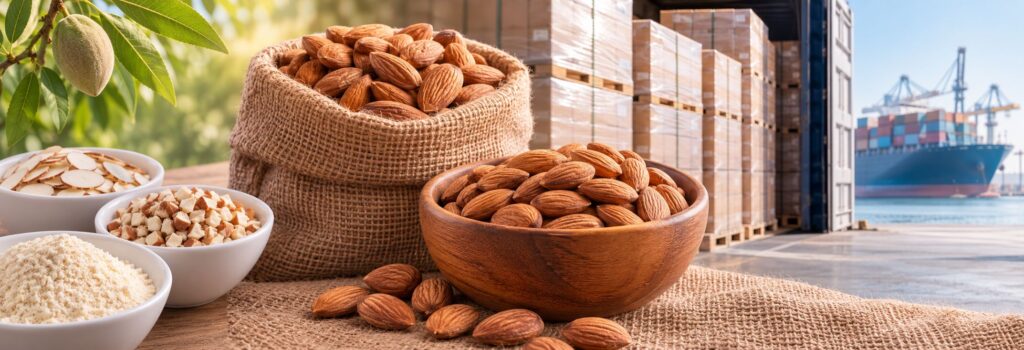
A bulk almond supplier is a company that sells almonds in large volumes, usually by the pallet or container, to importers, retailers, and food manufacturers. Sourcing at this scale requires more than good taste and fair pricing.
Buyers need consistent grading, verified lab testing, correct export documentation, and a supply that holds steady throughout the year, not just at harvest.
This guide explains what to look for in a wholesale almond supplier, what documents should ship with every export order, and how to choose the right product grade for retail, export, or manufacturing use.
Why Bulk Almond Sourcing Is Different
A retail buyer cares about flavor and price per pack. A wholesale buyer has a different set of problems:
- Consistency across large volumes: One off-spec pallet in a 20-ton order can hold up an entire shipment at customs.
- Documentation that matches the destination market: The EU, the US, and Gulf states all want different paperwork.
- Supply Reliability: Through the year, not just during the harvest season.
- Traceability: Especially for buyers supplying retail chains or food manufacturers with their own compliance teams.
Getting these right depends almost entirely on who you’re buying from, not just what you’re buying.
Also Read: Top Healthy Dried Fruits and Nuts You Should Eat Every Day
What to Look For in a Bulk Almond Supplier
1. Direct Sourcing vs. Trading
Some companies grow or process almonds themselves. Others buy from processors and resell at a markup, adding a layer between you and the actual product. Neither model is inherently wrong, but direct producers usually give you:
- Better pricing, since there’s no trader margin stacked on top.
- More accurate information about crop quality and availability.
- Faster answers when something changes with your order.
Ask directly: does this company grow or process the product, or are they reselling someone else’s stock? A straight answer to that question tells you a lot.
2. Certifications and Food Safety Standards
Bulk buyers, especially those supplying retail or manufacturing clients, need paperwork that stands up to an audit. Look for suppliers holding recognized certifications such as:
- BRC (British Retail Consortium) or FSSC 22000 for food safety management.
- USDA Organic and EU Organic for organic product lines.
- Kosher certification for buyers serving those markets.
- ISO-aligned facility standards, including on-site microbiological testing.
A supplier who can produce this documentation on request, per shipment, is operating differently than one who can only offer a general company brochure.
3. Lab Testing and Quality Verification
Every batch should be tested before it leaves the facility. That typically means:
- Pesticide residue screening
- Microbiological testing
- Moisture content checks
- Foreign matter and sizing inspection, done by both machine and hand
Reputable suppliers send lab reports to the buyer before the shipment is loaded, not after it arrives. If a supplier can’t tell you what testing happens before export, that’s a gap worth asking about directly.
4. Grade, Size, and Format Options
Bulk almond buyers rarely want just one product. Depending on your end use, you might need:
- Natural whole almonds for bulk snacking and retail repacking.
- Roasted almonds with extended shelf stability.
- Sliced, diced, or powdered almonds for cereal, snack bars, and bakery lines.
- Organic almonds for clean-label and certified product ranges.
A supplier who carries this full range under one roof means fewer vendor relationships to manage, and fewer chances for a supply gap to hurt your production schedule.
Export Documentation: What Should Ship With Every Order
Getting almonds through customs without delays comes down to paperwork prepared correctly the first time. A supplier experienced in export should handle:
- Certificates of origin
- Phytosanitary certificates
- Health certificates
- Lab test reports covering the specific batch shipped
Each destination market has its own labeling and import requirements. A supplier that regularly exports to the EU, UK, US, Canada, Gulf Cooperation Council countries, and Southeast Asia should already know what your customs team needs, without you having to explain it.
Packaging for Wholesale and Manufacturing Buyers
Packaging needs shift depending on who’s receiving the product. Common formats in bulk almond trade include:
- Standard carton boxes, typically in weights suited for food service and wholesale distribution.
- Bulk sacks, palletized to US or Euro pallet specifications for container loading.
- Small retail packs, in plastic, PVC, or thermoform formats for shelf-ready products.
- Private label packaging, built around a buyer’s own branding, barcode, and regulatory labeling.
Container capacity matters too. Most bulk shipments move in 20-foot or 40-foot full container loads (FCL), so confirm your supplier handles both regularly rather than treating large orders as a special exception.
Sourcing for Manufacturing: A Few Extra Questions
If you’re buying bulk almonds as an input for bakery, confectionery, snack, or plant-based dairy production, add these to your supplier checklist:
- Can they hold consistent size grading across repeat orders?
- Do they offer sliced, diced, or flour-grade formats without a separate processing partner?
- Can they scale supply through the year, or only right after harvest?
- Is organic product kept on separate equipment from conventional lines?
Manufacturers depend on ingredient consistency more than almost any other buyer type. A single inconsistent shipment can throw off a production formula that took months to dial in.
Also Read: 10 Best Nutritious Snacks for High-Energy Lifestyles
Why Malatya Apricot is a Reliable Bulk Almond Partner
Malatya Apricot supplies almonds alongside a full range of dried fruits, nuts, and kernels, backed by a processing facility built to European and international food safety standards, including BRC, FSSC 22000, USDA Organic, EU Organic, and Kosher certification.
Every batch goes through sorting, lab testing, and metal detection before packing, and full export documentation ships with every order.
Our almond range covers:
- Natural whole almonds for bulk snacking and retail supply.
- Roasted almonds for extended shelf life and flavor.
- Sliced, diced, and powdered almonds for bakery, confectionery, and health food manufacturing.
- Organic almonds certified to international standards.
Our products are exported to EU countries, the UK, the US, Canada, Gulf Cooperation Council countries, and Southern Asia; each of our customers will be given a separate export account, which will get back to you within one working day.
If your design gets approved, we can provide private labeling and packing services; shipment will be carried out using US or Euro pallets in 20 FCL and 40 FCL containers.
For bulk almonds procurement for export, retail, or manufacturing purposes, please contact our Export Department.
Conclusion
When sourcing wholesale almonds it’s a case of a few core checks: consistent grading, verified lab testing, correct export paperwork and a supplier who can sustain supply beyond the harvest season.
Producers who have known food safety certifications and are selling directly will typically have more reliable information and better pricing than traders who are reselling someone else’s stock.
For retail, export and manufacturing needs, Malatya Apricot has a range of almonds and full documentation on every shipment with certified processing to meet these standards. Contact our Export Department for samples, pricing, or current availability.