A fresh fig is a short-lived fruit. It lasts only a couple of days after picking. That is the reason people have dried figs for so long, and the reason buyers today can enjoy them months later and thousands of miles away.
But not every bag of dried figs is the same. Two packs can look alike on a shelf and still taste and feel very different. If you buy figs for a shop, a bakery, or a food business, knowing what to look for saves you money and complaints.
This guide covers what good dried figs feel like, how shape and variety affect your choice, what happens before the figs are packed, and how to store them. It is based on how we grow, dry, and pack figs in Malatya, Turkey.
What Should a Good Dried Fig Feel Like?
Start with the touch and the taste. These two checks tell you more than any label.
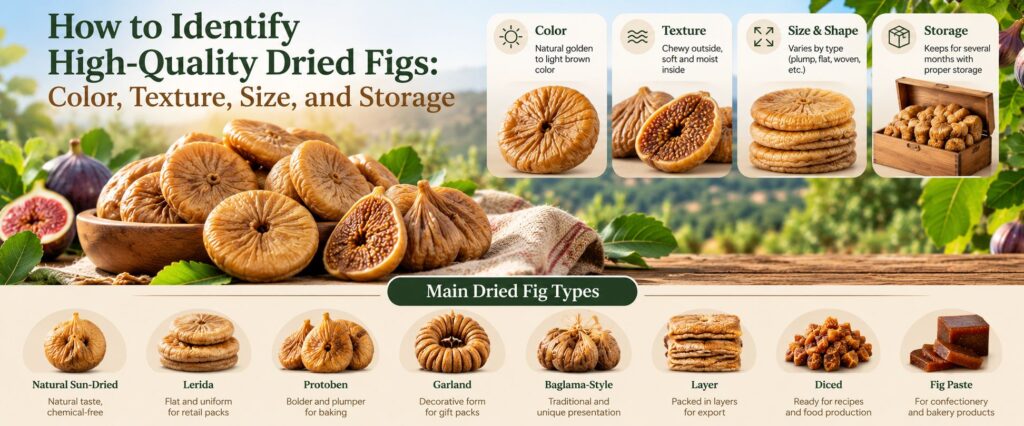
A well-dried fig is chewy and naturally sweet, with a honey-like taste. The skin wrinkles as the fruit dries. Inside, the fig stays soft and moist.
Use this as a simple checklist when you open a sample:
- The skin looks wrinkled, which is normal for a dried fig.
- The fruit is chewy when you bite it.
- The inside is soft and moist, not hard all the way through.
- The sweetness tastes natural, with a honey-like note.
A wrinkled outside with a soft inside is the sign you want. A fig that is hard through the middle does not match that description.
How Do Size and Shape Differ Between Fig Types?
Size and shape depend a lot on the type of fig you choose. We offer several styles, and each one suits a different job.
1. Plump figs for baking
Protoben dried figs are bolder and plumper. They are used in confectionery and bakery products.
2. Flat, even figs for packs and shelves
Lerida dried figs are flattened by hand. They have an even shape, which makes them a good fit for packaging and shop display. If your figs will sit in a retail pack where customers can see them, an even shape matters.
3. Woven figs for gifts and traditional markets
Garland and Baglama-style figs are interwoven into decorative forms. Garland figs are used for gift packs and traditional markets.
4. Other styles we offer
- Natural sun-dried figs: Dried under the hot Turkish sun, a chemical-free option.
- Pulled dried figs
- Layer dried figs: Packed in layers, an export packing style.
- Diced dried figs
- Fig paste
When you compare suppliers, ask which style you are really getting. A fig that suits a bakery may not be the best choice for a gift box.
What Happens Before Figs Reach the Pack?
Quality starts in the orchard and carries on through the factory. Here is our process for figs:
- Figs are handpicked at the right maturity.
- They are dried in the sun or air-dried in modern facilities.
- Controlled drying systems support sun drying, so large orders stay uniform.
- Inspectors check each batch before and after drying.
- Cleaning, sorting, grading, and packing are all done in-house.
- Quality checks run from washing through to packaging.
- Our farms use no pesticides of any kind.
Why does this matter to you? A supplier who can explain each step is easier to trust. If a seller cannot tell you how the figs were dried or checked, that is a reason to ask more questions.
Which Certifications Should You Ask About?
Certificates will not tell you how a fig tastes. They do tell you how the food was handled and checked.
Our dried figs carry these certifications and standards:
- HACCP
- ISO 22000
- BRC
- FDA, for the U.S. market
- We also align with FSSAI rules for India and with EU regulations.
When choosing any figs supplier, look for four things:
- Safety certifications
- Export experience
- Hygienic packaging
- Transparent sourcing
Always ask to see the paperwork for your own market before you place a large order.
How Long Do Dried Figs Keep, and How Should You Store Them?
Dried figs keep far longer than fresh ones. They can be kept for several months without losing flavor or nutritional benefits. A fresh fig, as noted above, lasts a couple of days.
We do not set storage temperatures or humidity levels in this guide. If you need exact storage settings for your order, ask us for written guidance when you place it.
Packaging can also help you plan. Our figs come in these sizes:
- Retail packs: 250 g, 500 g and 1 kg
- Bulk packs: 10 kg, 12.5 kg and 14 kg
Custom branding, labeling and packaging design are available too. A smaller pack is a sensible choice if you sell slowly. A bulk pack suits a busy kitchen or a factory line. Pick the size that you will use within the months the figs keep.
What Do Dried Figs Contain?
Our dried figs provide:
- Dietary fiber
- Calcium
- Iron
- Magnesium
- Potassium
- Antioxidants
They have zero cholesterol and zero saturated fat, and they suit vegan and vegetarian diets. For everyday use, think breakfast, smoothies, salads, and baking.
FAQs (Frequently Asked Questions)
1. Which markets do you export dried figs to?
Our figs go to the United States, the United Kingdom, Germany, France, India, Japan, and the United Arab Emirates, among others.
2. How are the figs shipped?
Figs can be shipped by air or by sea.
3. Where do the figs come from?
They come from Turkey, from the Malatya region.
4. Can buyers use their own branding?
Yes, we offer custom branding, labeling, and packaging design, along with retail-ready packs and bulk shipments.
5. What do I check first when I get a sample?
Check the feel and the taste. Look for chewy flesh, a soft and moist inside, a wrinkled skin, and natural sweetness. Then check that the shape suits your use.
Good dried figs are chewy, naturally sweet and soft inside, with skin that wrinkles as they dry. The right size and shape depend on your goal. Protoben figs are plump and suit baking. Lerida figs are flat and even, which works well for packs and displays. Garland and Baglama figs are made for gifts and traditional markets.
Look at how the supplier works, too. Handpicking, careful drying, in-house cleaning, sorting and grading, and checks before and after drying all point to a supplier who pays attention. Certifications such as HACCP, ISO 22000, and BRC add another layer of confidence. Stored well, the figs keep for several months.
If you want to buy dried figs from Malatya, Turkey, we are ready to help. Visit malatyaapricot.com and use the contact page to ask about fig types, pack sizes, and shipping for your market.