Figs have been on the table for thousands of years. Ancient Egyptians, Greeks, and Romans loved them as a source of strength and as medicine, and in those days the fruit stood for prosperity and fertility. Today dried figs turn up in snack bowls, breakfast cereals, bakeries, and gourmet kitchens all over the world.
There is a good reason they traveled so well. A fresh fig is delicate and spoils fast, often within a couple of days of harvest. Drying solves that. Once dried, figs keep for several months and hold on to their flavor.
For a buyer, though, “dried figs” is not one single product. The shape, texture, look, and pack all change from one type to the next. This guide covers the main types, the pack sizes, how quality is checked, and what to ask a supplier before you order.
What Are Dried Figs?
Dried figs are fresh figs that have been dried, either in the sun or by controlled air-drying in a modern facility. Drying concentrates the natural sugars. That is where the sweetness and the slightly chewy bite come from.
The skin turns wrinkly while the inside stays soft, moist, and sweet. They also keep the main nutrients of fresh figs, including dietary fiber, calcium, iron, and antioxidants.
Dried Fig Types Explained
Different buyers want different figs. A retailer cares about how the fruit looks on a shelf. A baker cares about how it works in a recipe. Malatya Apricot, a Turkish supplier and exporter based in Malatya, offers a wide range of fig types to cover both.
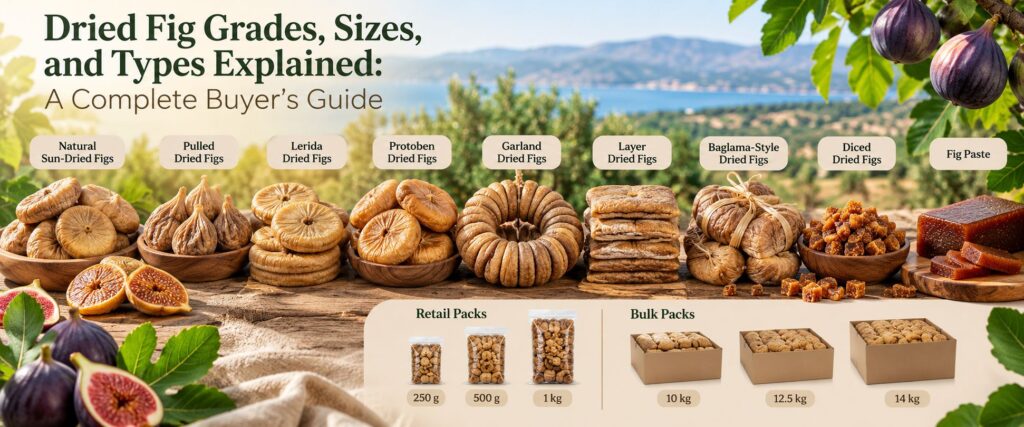
The range includes:
- Natural Sun-Dried Figs
- Pulled Dried Figs
- Lerida Dried Figs
- Protoben Dried Figs
- Garland Dried Figs
- Layer Dried Figs
- Baglama-Style Dried Figs
- Diced Dried Figs
- Fig Paste
What Sets Each Type Apart
Here is how the main types differ when you are choosing between them.
- Natural Sun-Dried Figs: Dried under the hot Turkish sun to keep their original taste and natural sweetness. A good match for buyers who want a chemical-free option.
- Lerida Dried Figs: Flattened by hand into an even, tidy shape. That uniform look is usually preferred for packaging and shop display.
- Protoben Dried Figs: Bolder and plumper than the rest. They are commonly used in the confectionery and bakery sectors.
- Garland and Baglama Dried Figs: Woven together in decorative forms. They suit gift packs and traditional markets.
- Layer Dried Figs: Packed in layers, which makes them an easy and appealing choice for export packing.
Pulled Dried Figs, Diced Dried Figs and Fig Paste are also part of the range.
So which type is right for you? If shelf appearance matters most, Lerida is worth a look. If you bake or make confectionery, Protoben is the one to look at. If you are building a gift pack, Garland and Baglama were made for that. And if you want the simplest, most natural option, start with the sun-dried figs.
Dried Fig Pack Sizes
Pack size shapes almost everything that comes after it: shelf space, freight, handling, and price per unit. A small retail pack is made for a supermarket aisle. A large carton is made for a warehouse or a production line. It helps to decide which of the two you need before you compare suppliers.
Buyers often ask what pack sizes are available for dried figs. Malatya Apricot offers them in two groups.
- Retail packs: 250 g, 500 g and 1 kg. These suit supermarkets and health stores.
- Bulk packs: 10 kg, 12.5 kg and 14 kg. These are meant for wholesalers and industrial customers.
Brands that want to sell dried figs under their own name can use private label. The team handles branding and labeling, and also helps with packaging design so the product stands out on the shelf. Malatya Apricot is also flexible on packaging, quantities, and product specifications, so it is worth sharing your exact needs early.
How Quality Is Checked Before Figs Ship
Quality control at Malatya Apricot runs from the farm to the factory. Inspectors check every batch both before and after drying. The steps look like this:
- Figs are handpicked at the right stage of maturity.
- They are dried naturally, with sun-drying as the base.
- Controlled drying systems work alongside the sun so that large batches stay uniform.
- Processing units handle cleaning, sorting, grading, and packaging.
- Several quality checks take place between washing and final packing.
The goal is to protect the natural character of the fig while meeting food safety requirements. The factory is hygienic, with trained staff and modern equipment.
Safety Certifications to Look For
A fig can look perfect and still fail a safety audit. That is why certifications matter. Malatya Apricot is certified to operate under these standards:
- HACCP
- ISO 22000
- BRC
- FDA, for the U.S. market
It also says it follows FSSAI standards in India and EU regulations in European countries. In plain terms, these systems exist to show that the figs were grown, processed, and packed in safe and hygienic conditions.
Where Do the Dried Figs Ship?
Malatya Apricot exports dried figs to the United States, the United Kingdom, Germany, France, India, Japan and the United Arab Emirates, among other markets.
The export department handles certifications, documents, delivery, and logistics. Orders can go by air or by sea, and they can be retail-ready or bulk.
What to Check When Choosing a Dried Fig Supplier
Price is only one part of the decision. A reliable supplier should be able to show you:
- Safety certifications for their products
- Consistent, high-quality fruit
- Real experience in exporting
- Hygienic packaging
- Clear, open sourcing
- The ability to handle large orders
If a supplier cannot answer one of these, ask again before you place a large order.
A Quick Word on Turkish Figs
Are Turkish dried figs better than regular dried figs? Turkish figs are widely respected. Turkey has a favorable climate, fertile soil, and long experience in drying figs. Turkish figs are known for natural sweetness, good taste, and export quality at reasonable prices.
Dried figs are not all alike, and the right choice depends on what you plan to do with them. Here is the short version:
- Types: Sun-dried, pulled, Lerida, Protoben, Garland, Layer, Baglama-style, Diced, and fig paste each serve a different need.
- Pack sizes: Retail packs come in 250 g, 500 g, and 1 kg. Bulk packs come in 10 kg, 12.5 kg, and 14 kg.
- Quality: Batches are inspected before and after drying, then cleaned, sorted, graded, and checked again before packing.
- Certifications: HACCP, ISO 22000, BRC, and FDA are listed for the U.S. market, along with alignment with FSSAI and EU rules.
- Private label: Branding, labeling, and packaging design are available.
Ready to talk about fig types, pack sizes, or private label packaging for your market? Contact the Malatya Apricot export team and tell them what you need.