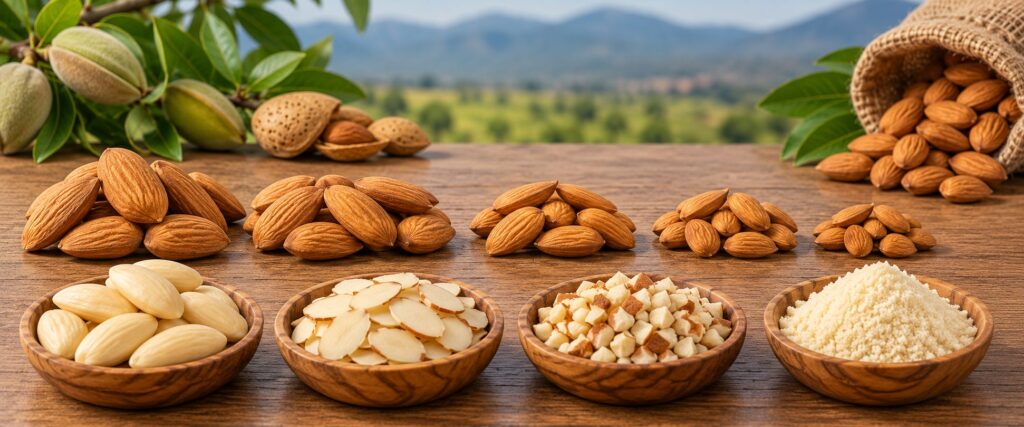
Two boxes of almonds can look similar on a quotation and behave very differently once they reach a packing or production line.
One batch may contain large, uniform kernels that look excellent in a transparent retail pouch. Another may contain smaller almonds that are perfectly suitable for slicing, grinding or confectionery. Both can be good-quality products. They simply serve different purposes.
This is why professional almond buyers look beyond the word “almonds” on a specification sheet.
Size, variety, kernel condition, defects, moisture, processing format and intended use all influence whether a particular lot is right for the job.
Understanding almond grades and sizes makes it easier to compare offers from different suppliers and, more importantly, prevents a business from paying for a specification it does not actually need.
How Are Almonds Graded?
There is no single worldwide almond grade that tells a buyer everything about a product.
Commercial almonds are normally evaluated through a combination of characteristics, including:
- Kernel size
- Variety
- Shape and uniformity
- Color and appearance
- Whole or broken kernels
- Chips and scratches
- Moisture
- Foreign material
- Processing method
- Defect tolerances
This is an important difference from products where buyers may rely heavily on one familiar grade code.
With almonds, the complete specification matters.
A size count can tell you roughly how large the kernels are, but it cannot tell you whether the lot meets your requirements for appearance, defects, moisture or processing.
For commercial buyers, grade and size should therefore be read together rather than treated as the same thing.
Understanding Almond Size Counts
Almond sizing is commonly expressed as a count range.
You may see specifications such as:
18/20, 20/22, 23/25, 25/27, 27/30, 30/32 or 32/34.
These numbers indicate approximately how many almond kernels make up a specified unit of weight under the applicable commercial sizing system.
The basic principle is easy to remember:
A lower count generally means a larger individual almond.
A lot graded 18/20 therefore contains larger kernels than a 30/32 lot.
Why?
Because fewer large almonds are needed to reach the same weight. Smaller kernels require a greater number.
That makes the count useful when buyers need consistency in physical appearance.
Does a Larger Almond Mean Better Quality?
Not necessarily.
This is probably the most common misunderstanding surrounding almond sizing.
Size describes size. It does not, by itself, define quality.
A large almond with poor color, excessive damage or unsuitable moisture is not automatically better than a smaller, well-sorted almond that perfectly meets a manufacturer’s specification.
The correct size depends on the finished product.
Imagine a company producing a premium snack pack where every almond is clearly visible through the packaging. Large, visually uniform kernels may add value because appearance is part of the consumer experience.
Now consider a bakery that will grind the almonds before they enter production.
The bakery receives little benefit from paying extra purely for impressive-looking whole kernels. Consistency, flavor, food safety and processing performance may be considerably more important.
The best specification is therefore not always the largest almond available.
It is the almond that suits the application.
Common Almond Size Ranges
Commercial specifications can vary by origin, variety and supplier, but buyers will commonly encounter a range of size counts.
A simplified way to think about them is:
| Size Count | Relative Kernel Size | Typical Consideration |
|---|---|---|
| 18/20 | Very large | Premium presentation and applications emphasizing kernel size |
| 20/22 | Large | High-visibility retail and premium products |
| 23/25 | Medium-large | Attractive presentation with wider commercial use |
| 25/27 | Medium-large | Retail, snacking and food-service applications |
| 27/30 | Medium | Versatile for numerous food applications |
| 30/32 | Smaller | Processing and applications where very large kernels are unnecessary |
| 32/34 | Smaller | Ingredient applications and products where size has less visual importance |
These descriptions are useful for orientation, but professional buyers should always confirm the actual specification supplied with a lot.
Size terminology can vary, and the count should never replace an agreed product specification.
Almond Variety Matters Too
Size is only one part of the buying decision.
Almond varieties differ naturally in shape, color, shell characteristics, texture and flavor. Some kernels are relatively long and narrow. Others are broader or rounder. Skin appearance can also differ.
That matters because two almonds with similar size counts may not look identical in a finished retail product.
For a manufacturer turning almonds into paste or flour, these visual differences may have limited importance. For a company selling whole natural almonds in clear packaging, they can matter considerably.
This is why buyers should avoid selecting almonds from a size number alone.
Variety + size + specification + end use provides a much more useful purchasing framework.
Businesses comparing available product formats can see Malatya Apricot’s almond range for information on almonds supplied for retail, food manufacturing and international markets.
Natural Almonds vs Blanched Almonds
Another specification buyers encounter is whether almonds are natural or blanched.
Natural almonds
Natural almonds retain their brown skin.
They are commonly used for direct snacking, roasting, mixed nuts, cereal products and numerous bakery applications.
The skin gives the almond its familiar appearance and contributes to the texture and visual character of the finished product.
Blanched almonds
Blanching removes the skin, leaving a lighter-colored kernel.
This format is useful when manufacturers want a cleaner, pale appearance or need almonds for further processing into products such as confectionery, bakery ingredients, pastes or decorative toppings.
Neither format is universally better.
The decision again comes back to what the manufacturer intends to do with the ingredient.
Whole, Sliced, Diced or Ground?
Professional almond purchasing extends well beyond whole kernels.
Malatya Apricot’s almond range includes formats intended for different industry applications, including sliced, diced and powdered products. These formats are particularly relevant to bakery, confectionery, cereals, snacks and other manufactured foods.
Whole almonds
Whole kernels make sense when the almond itself remains visible in the finished product.
Typical applications include snack packs, mixed nuts, roasted products and retail repacking.
Sliced almonds
Sliced almonds provide a recognizable almond appearance without the weight and bite of a whole kernel.
They are commonly considered for bakery toppings, cereals, desserts and food-service applications.
Diced almonds
Diced almonds distribute more evenly through a formulation.
They can work well in chocolate, confectionery, bakery products, snack bars and other foods where manufacturers want almond pieces throughout the product rather than one large kernel.
Almond powder or flour
Once the almond is finely processed, whole-kernel appearance becomes largely irrelevant.
Particle size, flavor, moisture, processing consistency and food-safety specifications become much more important.
This is a good example of why buying the most visually impressive whole almond is not always commercially sensible.
How Professional Buyers Should Choose an Almond Size
Start with the finished product.
That one decision can eliminate many unnecessary specifications.
For premium retail packs
Appearance matters.
Buyers may prefer larger, uniform kernels with good color and minimal visible damage because consumers can see exactly what they are buying.
For roasted almond products
Uniformity becomes particularly important.
When kernels vary significantly in size, roasting behavior can also vary. A consistent specification helps manufacturers achieve a more predictable finished product.
For mixed nuts
The almond needs to work visually and physically alongside the other ingredients.
A very large almond may dominate the mix, while an excessively small one may disappear among cashews, raisins, pistachios or other components.
For bakery and confectionery
Ask whether the almonds remain whole.
If they will eventually be sliced, diced, ground or covered in chocolate, paying primarily for large whole-kernel appearance may not add value.
For almond butter, paste or flour
Processing characteristics become more important than visual size.
Buyers should focus on the specification that supports consistent production rather than simply choosing the largest kernel.
What Else Should Be on an Almond Specification?
A professional almond specification should answer more than “What size is it?”
Depending on the application and destination market, buyers may need information covering:
- Variety and origin
- Size or count
- Moisture
- Whole-kernel percentage
- Broken or chipped kernels
- Foreign material
- Color
- Processing format
- Microbiological requirements
- Pesticide-residue requirements
- Packaging
- Shelf life
- Storage conditions
- Lot identification
- Traceability
The exact requirements will differ between a retailer, snack company, bakery and ingredient processor.
The important point is to establish them before a large order is produced and shipped.
Why Uniformity Matters in Commercial Orders
For a household buying a small bag of almonds, a few slightly larger or smaller kernels rarely matter.
For a food manufacturer running thousands of units through a production line, inconsistency can become expensive.
Suppose one shipment contains noticeably different kernel sizes from the previous lot. A roasting program developed around the earlier specification may no longer behave exactly the same way. A retail pack may also look different even though its label has not changed.
Consistency becomes particularly important when businesses are purchasing repeatedly throughout the year.
That is why experienced buyers compare samples and specifications rather than relying solely on photographs.
Size Is Only One Part of Quality Control
Once buyers understand almond sizing, the next temptation is to make it the central quality measure.
That would be a mistake.
Commercial quality control can also involve moisture checks, foreign-matter inspection, defect assessment, microbiological testing and other requirements relevant to the destination market and customer’s specification.
The existing Bulk Almond Supplier Guide goes deeper into supplier evaluation, laboratory testing, certifications, export documentation and repeat-order consistency.
That guide is particularly useful once a buyer moves from understanding the product to evaluating a potential supply arrangement.
Packaging and Storage Should Match the Product
Almond quality does not stop at grading.
After processing and inspection, the product still needs to survive storage, loading, international transport and warehousing before reaching the customer’s production line.
Packaging therefore needs to protect the almonds from conditions that could affect quality.
The appropriate format depends on order size, destination and whether the product is intended for industrial use, food service, retail packing or private label.
Malatya Apricot provides information about its available packaging solutions for international shipments.
Buyers should confirm packaging specifications at the same time as product specifications rather than treating packaging as an afterthought.
Buying Almonds Alongside Other Nuts and Dried Fruits
Many importers and manufacturers do not purchase almonds in isolation.
The same procurement program may include cashews, dried figs, raisins, dates or dried apricots.
In these cases, understanding how each commodity is graded makes supplier conversations much easier.
Cashews, for example, use a different grading language. If your purchasing team also works with cashews, our guide to cashew grades W180, W210, W240, W320 and W450 explains how those classifications differ by kernel size.
Buyers sourcing across several categories can also explore Malatya Apricot’s dried fruits and nuts range.
Questions to Ask Before Approving an Almond Lot
A short conversation with the supplier can prevent a much longer conversation after delivery.
Before approving an almond specification, ask:
What variety is being supplied?
Variety can affect shape, appearance and processing characteristics.
What is the size count?
Do not settle for descriptions such as “large” or “medium” if precise sizing matters to your product.
What defect tolerances apply?
Agree on what is acceptable before shipment.
What is the moisture specification?
Moisture is an important part of product consistency and storage.
Is the product natural, roasted, blanched, sliced, diced or ground?
Make sure both parties are describing exactly the same format.
Can a representative sample be supplied?
For significant commercial orders, evaluating the actual product is more useful than relying on a generic product photograph.
Will repeat orders follow the same specification?
Consistency matters when the almonds become part of an established recipe or retail SKU.
Frequently Asked Questions About Almond Grades and Sizes
What do almond size numbers mean?
Almonds are commonly sold using count ranges that indicate kernel size. In general, lower counts correspond to larger individual almonds, while higher counts indicate smaller kernels.
Which almond size is best?
There is no universal best size. Larger kernels can be valuable for premium presentation, while smaller sizes may be perfectly suitable for processing, bakery, confectionery or other ingredient applications.
Are larger almonds higher quality?
Not automatically. Size is only one characteristic. Overall quality can also depend on appearance, moisture, defects, freshness, processing and food-safety specifications.
What is the difference between almond grade and almond size?
Size describes the physical dimensions or count of the kernels. Grade is broader and can incorporate factors such as appearance, defects, kernel condition and other quality characteristics.
Should manufacturers buy whole almonds if they will be chopped?
Not necessarily. If the production process ultimately slices, dices or grinds the almond, buyers should compare processed formats and specifications rather than paying primarily for whole-kernel appearance.
Why does almond size matter for roasting?
Consistent kernel dimensions can help support more uniform processing. When very different sizes are processed together, they may not behave identically under the same roasting conditions.
The Practical Rule: Buy for the Application
Almond grading becomes much simpler when purchasing teams work backwards from the finished product.
If the almond will be displayed whole in premium retail packaging, size and visual uniformity deserve considerable attention.
If it will be roasted, processing consistency matters.
If it will be sliced for bakery use, diced into confectionery or ground into flour, paying extra solely for an impressive whole kernel may not make economic sense.
The goal is not to purchase the biggest almond.
It is to purchase the right almond specification for the product you are making or selling.
For current almond formats, specifications, packaging options or export enquiries, visit the Malatya Apricot almonds page or contact the Export Department.