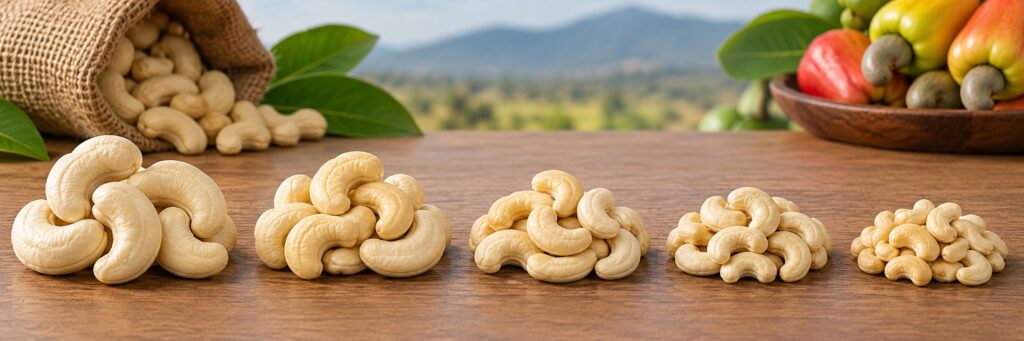
Put a W180 cashew next to a W450 and the difference is obvious. One is noticeably larger than the other. Put W240 and W320 side by side, however, and the distinction can be harder to judge unless you work with cashews regularly.
That is where cashew grading becomes useful.
Grades such as W180, W210, W240, W320 and W450 give buyers a common language for discussing kernel size and appearance. For a food business, understanding those numbers is more than industry knowledge. Grade influences presentation, application and, quite often, the price a buyer is prepared to pay.
Here is what the main cashew grades mean and how businesses can decide which one fits their product.
What Does the “W” in Cashew Grades Mean?
The W stands for “Whole White.” It describes a whole cashew kernel that falls within the relevant color and quality classification.
The number that follows is related to the approximate number of kernels in one pound.
This creates a grading system that initially seems backwards:
Lower grade number = larger individual cashew kernel.
So W180 kernels are much larger than W450 kernels.
The easiest way to understand it is to imagine filling the same one-pound container with cashews. If the nuts are very large, fewer are required to reach one pound. If they are smaller, considerably more kernels fit into the same weight.
The grade therefore does not mean that a W180 cashew weighs more in total than a W320 shipment. Buyers are still purchasing by weight. It describes the size classification of the individual kernels within that shipment.
W180 Cashews: The Large Premium Grade
W180 sits at the large end of commonly traded whole cashew grades. The kernels make an immediate visual impression, which is precisely why buyers tend to reserve them for products where appearance matters.
You are more likely to find this size in premium nut selections, gift boxes and high-end retail packs than hidden inside a cake or ground into a paste.
For a manufacturer, that distinction matters.
There is little commercial advantage in paying for an exceptionally large whole kernel if it will eventually be chopped into small pieces. But when the consumer opens a transparent retail pouch and sees the whole nut, size becomes part of the product’s perceived value.
W180 is commonly considered for:
- Premium retail nut packs
- Gift and gourmet assortments
- Luxury snack ranges
- Products where large whole kernels are a visible feature
Its larger size generally puts W180 toward the premium end of the market.
W210 Cashews: Large Without Going to the Extreme
W210 is still a large cashew, but gives buyers another option below W180.
This grade can work particularly well when a business wants the visual impact of a substantial whole kernel without necessarily specifying the largest category available.
Think of a premium mixed-nut product. The cashew needs to look substantial alongside almonds, pistachios or other nuts, but paying for W180 may not always make commercial sense. W210 can provide a useful middle ground.
Applications include premium snack packs, higher-end retail products and mixed-nut selections where the cashew remains visible to the customer.
W240 Cashews: A Balance Between Size and Practicality
Move down to W240 and the conversation begins to shift from pure visual impact toward versatility.
W240 kernels are still relatively large and attractive in a retail pack. At the same time, the grade can be practical for businesses that need good presentation without specifying one of the very largest cashews.
That makes W240 relevant across a wide range of applications, including:
- Retail snack packs
- Roasted and seasoned cashews
- Mixed nuts
- Confectionery
- Premium food-service applications
For procurement teams, W240 is worth comparing directly with W320. The decision often comes down to how visible the cashew will be in the finished product and whether the larger appearance justifies the difference in cost.
W320 Cashews: The Familiar All-Rounder
If there is one grade that buyers encounter repeatedly, it is W320.
There is a practical reason for that. The kernels are large enough to look appealing when sold whole but not so oversized that they are restricted mainly to premium presentation.
That versatility allows W320 to work across retail packs, roasted products, mixed nuts, confectionery and numerous food-manufacturing applications.
Imagine two products.
The first is a clear 200-gram pouch of roasted cashews sold on a supermarket shelf. The second is a nut mix used by a hotel or food-service operator. Both need recognizable, attractive whole kernels, but neither necessarily requires an unusually large cashew.
W320 can make sense in both cases.
That does not automatically make it the “best” cashew grade. There is no single best grade for every buyer. The right choice depends on what happens to the kernel after it reaches the customer.
Businesses looking at commercial quantities and available formats can view Malatya Apricot’s cashew supply and export range for further product information.
W450 Cashews: Smaller Whole Kernels with Plenty of Uses
W450 kernels are smaller than W180, W210, W240 and W320, but they are still whole cashews.
That last point is important.
A smaller whole cashew should not automatically be confused with a broken or defective kernel. Size and physical condition are separate considerations.
W450 can be useful when a buyer wants whole cashews but large visual presentation is not the main requirement. Depending on the final product, smaller kernels can make commercial sense for food manufacturing, confectionery, bakery applications, mixes and other products where the cashew is combined with additional ingredients.
Paying a premium for very large kernels only to chop or cover them during production is rarely an efficient specification.
W180 vs W210 vs W240 vs W320 vs W450
Here is a simple way to compare the five grades:
| Cashew Grade | Relative Kernel Size | Typical Consideration |
|---|---|---|
| W180 | Very large | Premium presentation and gourmet products |
| W210 | Large | Premium retail and visible whole-kernel applications |
| W240 | Medium-large | Strong presentation with broader versatility |
| W320 | Medium | Versatile whole-kernel applications |
| W450 | Smaller | Applications where whole kernels are needed but large size is less important |
The pattern is straightforward: as the number increases, the individual kernel becomes smaller.
But size alone should never be the entire buying specification.
Does a Bigger Cashew Always Mean Better Quality?
No.
This is one of the most useful distinctions for buyers to understand.
Size is not the same thing as overall quality.
A large cashew may look impressive, but a professional buyer also needs to consider factors such as color, moisture, breakage, taste, cleanliness, storage condition and consistency from one lot to another.
A beautifully sized kernel that has been stored poorly is not automatically preferable to a smaller kernel handled correctly.
The intended application matters too.
If a confectionery company is going to crush cashews before adding them to a product, buying W180 simply because it is larger could add cost without improving the finished food. A premium snack brand selling whole cashews has a very different requirement.
This is why professional purchasing should start with the final application and work backwards to the grade.
What About Cashew Splits and Pieces?
Not every business needs whole kernels.
Cashews that split or break during processing can be classified into other commercial forms. These can be particularly useful in products where the original whole shape will not be visible anyway.
Bakeries, confectionery manufacturers, cereal producers and ingredient companies may use splits or pieces because the cashew will eventually be chopped, mixed, coated or incorporated into another food.
This highlights an important purchasing principle: do not pay for appearance that your customer will never see.
A whole W240 may be appropriate for a premium snack pouch. Cashew pieces may make considerably more sense in cookies or granola.
Choosing a Grade Based on the Finished Product
Instead of asking, “Which cashew grade is best?”, procurement teams can ask a more useful question:
“What does our finished product require?”
For premium retail presentation, larger whole grades may be worth considering.
For mainstream snack products, a versatile whole grade may provide the right combination of appearance and commercial practicality.
For manufacturing, where kernels are chopped, coated or processed, size may become less important than consistency, moisture specification and the percentage of broken pieces.
This application-first approach prevents businesses from over-specifying their raw material.
Grade Is Only One Line on the Specification Sheet
A purchase order that simply says “W320 cashews” leaves several questions unanswered.
Professional buyers may also need to agree on:
- Moisture requirements
- Color and appearance
- Permitted defects
- Broken-kernel tolerance
- Foreign-matter limits
- Packaging format
- Food-safety requirements
- Shelf-life expectations
- Lot identification and traceability
- Required shipment and quality documents
These details become increasingly important when cashews are being purchased for manufacturing or repeated international shipments.
For a deeper look at specifications and supplier evaluation, read our Bulk Cashew Nuts Supplier Guide: Grades, Specifications, and Sourcing for Food Manufacturers.
Packaging Matters After the Grade Has Been Selected
A correctly graded cashew still has to arrive in good condition.
Long-distance transport exposes food products to changing temperatures, humidity and handling conditions. Appropriate food-grade packaging helps protect kernels from moisture, air and contamination during storage and transit.
This is especially relevant for importers purchasing larger commercial quantities, where a quality problem does not affect one retail bag—it can affect an entire shipment.
Malatya Apricot provides different packaging options according to product and shipment requirements.
Buying Several Nuts and Dried Fruits?
Cashews are often only one item on a buyer’s procurement list.
Snack manufacturers, importers and distributors may be purchasing almonds, pistachios, walnuts, dried figs, raisins or dried apricots at the same time. In that situation, understanding each product’s grading system helps purchasing teams write clearer specifications and compare quotations more accurately.
You can explore the wider dried fruits and nuts range if your sourcing program includes multiple products.
The same principle applies across categories: specify what the finished product actually needs rather than automatically choosing the largest or most expensive option.
Frequently Asked Questions About Cashew Grades
What does W320 mean in cashews?
W320 is a Whole White cashew grade. The number relates to the kernel count used in grading. It is a commonly specified whole-kernel size for a broad range of retail and food applications.
Which is bigger, W240 or W320?
W240 is larger. With these whole cashew grades, a lower number generally indicates a larger individual kernel.
Which is bigger, W180 or W450?
W180 is substantially larger than W450. They sit at very different points in the whole-kernel size range.
Is W180 better than W320?
Not automatically. W180 is larger and can be useful where premium visual presentation is important. W320 may be more appropriate for another application. Quality also depends on specifications beyond size.
What does the W stand for in cashew grading?
W means Whole White, referring to the form and color classification of the kernel.
Which cashew grade should food manufacturers choose?
It depends on the finished product. A manufacturer selling visible whole kernels may prioritize size and appearance, while a bakery or confectionery producer may place greater importance on consistency, processing performance and cost.
Final Thoughts
Cashew grades become much easier to understand once you stop treating the numbers as quality scores.
W180, W210, W240, W320 and W450 primarily help buyers distinguish different whole-kernel sizes. The lower the number, the larger the kernel. What matters commercially is choosing a size that suits the final product.
For a premium gift pack, appearance may justify a larger kernel. For a mainstream snack line, versatility may matter more. For bakery or confectionery production, paying extra for an oversized whole cashew that will eventually be chopped may offer little benefit.
Start with the product you intend to make or sell. Then specify the cashew that fits it.
For grade availability, specifications, packaging or export enquiries, visit the Malatya Apricot cashew page or contact the export team.