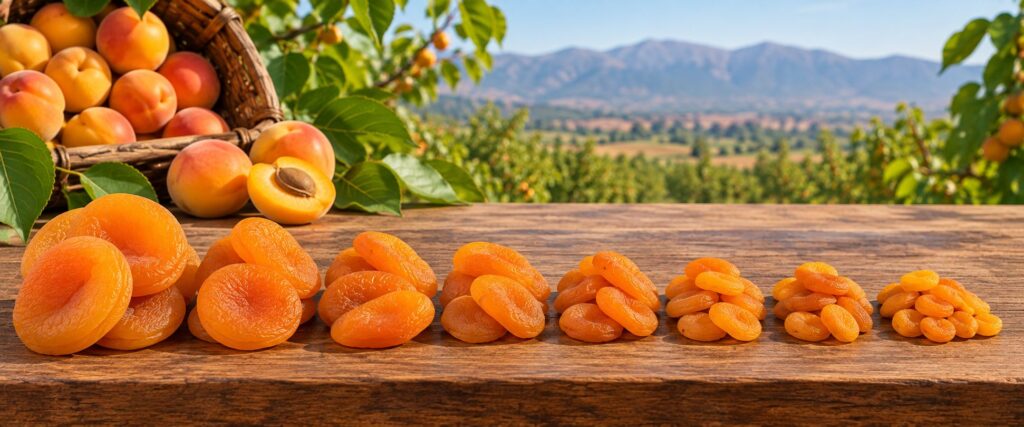
Dried Apricot Sizes Explained: What Size 1-8 Means for Professional Buyers
Turkey is the world’s biggest producer of dried apricots. Around 85% of its dried apricot output comes from one province, Malatya. If you buy at scale, you have probably read a spec sheet that said “size 3” or “size 6” and wondered what that really tells you.
Size matters more than it first seems. It affects how the fruit looks in a pack and how it is used further down the line. This guide explains the 1 to 8 scale, shows how apricots are sorted into each size, and lists what else a buyer should put into a spec.
What Do Dried Apricot Sizes 1 to 8 Mean?
Malatya Apricot grades its dried apricots from No. 1 to No. 8. No. 1 is the largest fruit, and No. 8 is the smallest. The lower the number, the fewer pieces it takes to make a kilogram. Each size is defined by a count per kilogram and a diameter.
Size Chart: Count per Kilogram and Diameter
Size 1: Up to 100 pieces per kg, 36 mm or larger
Size 2: 101 to 120 pieces per kg, 32 mm or 36 mm
Size 3: 121 to 140 pieces per kg, 29 mm or 36 mm
Size 4: 141 to 160 pieces per kg, 26 mm or 32 mm
Size 5: 161 to 180 pieces per kg, 24 mm or 29 mm
Size 6: 181 to 200 pieces per kg, 24 mm or 26 mm
Size 7: 201 to 220 pieces per kg, 21 mm or 26 mm
Size 8: 221 and over pieces per kg, 20 mm or less
How to Read the Chart
Count per kilogram is how many pieces fit in one kilo. Bigger fruit means a smaller count. So size 1 has up to 100 pieces, while size 8 has 221 or more. Buyers pick the caliber that fits what they are making or selling.
How Apricots Are Sorted Into Sizes
Sizing comes late in production, so it helps to see the steps before it.
Harvest: Apricots are handpicked in August and chosen for ripeness, color, and texture.
Drying and pitting: After the first drying phase, the apricots are pitted by hand. They then return to the drying beds for another three days.
Washing: Two rounds of washing with fresh water, using high pressure and soft brushes.
Inspection: Workers at inspection tables pull out any foreign material.
Sizing: A mechanical shaker grades the fruit from No.1 through No.8 before packing.
Metal detection: Every batch passes through a metal detector before final packing.
The shaker keeps each carton or shipment consistent in size, but it is not the only check. Each batch also goes through mechanical and hand sorting, and undersized, damaged, or off-color pieces are removed before packing.
Size Is Not the Same as Quality Class
Size tells you how big the fruit is. Quality class tells you how clean and sound it is. Malatya Apricot lists four classes: Extra, Class 1, Class 2, and Industrial. Each has its own limits for defects. Here are a few examples from the company’s specification table.
Dirty berries: 4% in Extra, 6% in Class 1, 12% in Class 2, 15% in Industrial.
Mouldy berries: 0% in Extra, 1% in Class 1, 2% in Class 2, 4% in Industrial.
Wormy berries: 0% in Extra, 1% in Class 1, 4% in Class 2, 8% in Industrial.
Live worms or insects: 0 per box in every class.
Dangerous foreign material, such as metal or glass: 0 per box in every class.
What Else Belongs on a Buyer’s Spec
Beyond size, buyers should consider sulfur treatment, sulfur dioxide levels, moisture content, and packaging options. These specifications help ensure the apricots meet market requirements and customer expectations.
Sulfured or unsulfured: Conventional apricots are treated with sulfur dioxide. Natural sun-dried apricots get no chemical treatment and come out darker.
For a more detailed comparison, read What Is the Difference Between Sulphured and Unsulphured Dried Apricots?
Sulfur level: Shipments to Europe stay below 2000 ppm, and buyers can ask for a specific ppm range for their market.
Moisture: For sun-dried apricots, moisture levels and size grades can be adjusted to your spec before packing.
Pack format: 5 kg and 12.5 kg cartons, 200 g and 400 g retail packs, or bulk sacks. Private label is available.
Ordering by Size: What to Tell Your Supplier
Malatya Apricot sorts fruit to the buyer’s retail or manufacturing spec before packing. When you place an order, it helps to name these three points:
Count per kilogram
Visual appearance
For seasonal sourcing context, read the 2026 Crop Turkish Dried Apricots Harvest Report.
Size uniformity
Timing matters too. The company holds buffer stock through the year, so you are not limited to the post-harvest window. Shipments go out in 20 FCL and 40 FCL containers, and each one leaves with its paperwork, including phytosanitary certificates, health certificates, lab reports, and certificates of origin.
Quality Checks Before Shipment
Samples go to an external accredited laboratory. The tests cover pesticide residues, sulfur dioxide levels where applicable, microbiological counts, and heavy metals. Reports reach the buyer before the shipment is loaded, and buyers can send their own inspector if they prefer.
Why Professional Buyers Choose Malatya Apricot for Quality and Size-Consistent Dried Apricots
Malatya Apricot is a Turkish producer, supplier, and exporter of natural dried apricots. It works from its own processing facility in the Battalgazi district of Malatya and buys directly from local farming families, with no middlemen. The company says it is not a trading company, and it handles processing, packing, and export itself.
Certifications: USDA Organic, EU Organic, BRC, FSSC 22000, Eco and Kosher. Each applies to specific product lines.
Range: Conventional, natural, sun-dried, diced, organic, and industrial dried apricots, plus apricot kernels.
Quality and service: An on-site microbiological lab and a dedicated export contact for every buyer.
Visits: Importers, QA managers and retail buyers are welcome to walk through the sorting lines and drying operations.
Sizes 1 to 8 run from the largest apricots to the smallest. Each size comes with a count per kilogram and a diameter, and a mechanical shaker does the sorting before packing. Size is separate from quality class, so a full spec should also name the class, the sulfur level, the moisture, and the pack format.
Ready to talk specs? Tell the Malatya Apricot export team the size, class, and pack you need, and they will match it. Replies come within one business day.