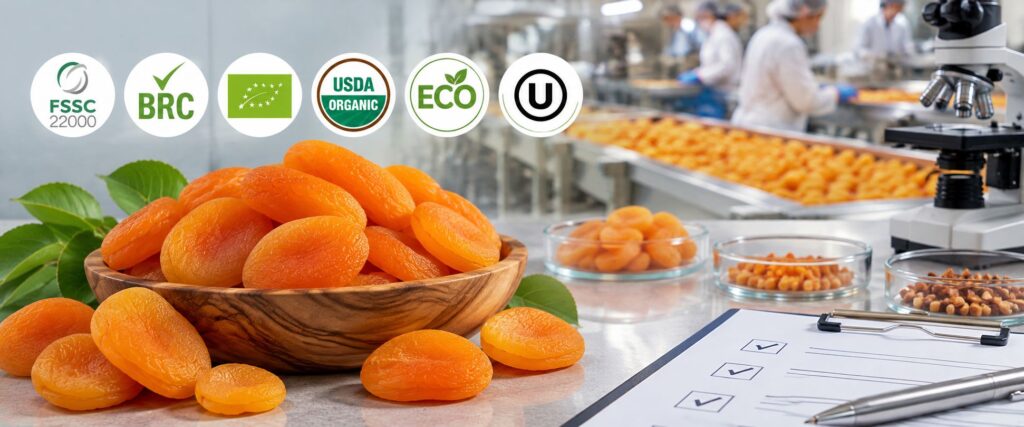
Food Safety Certifications for Nuts and Dried Fruits: What Buyers Should Know
Buying nuts and dried fruit from another country means trusting people you may never meet. You can’t open every sack or watch every wash cycle. So buyers lean on paper. Certificates, lab reports, and batch records stand in for the visit you can’t make.
That paper only helps if you know what it says. One certificate may cover a food safety system. Another may cover how a crop was farmed. A lab report describes one batch on one day, and a sourcing record tells you where the fruit came from. These are different tools, and a good buyer uses all of them.
This post explains the certificates buyers see most often, and the checks that should sit beside them. To keep things practical, it uses Malatya Apricot, a dried apricot producer and exporter based in Malatya, Türkiye, as a working example.
What Do the Main Food Safety Certificates Mean?
Each certificate answers a different question. Here is what the main ones cover.
1. FSSC 22000
FSSC 22000 stands for Food Safety System Certification. It is an international standard for food safety management systems. It is used alongside ISO 22000 and adds additional requirements for the food industry. A company that holds it has shown that it keeps food safety hazards under control.
2. BRC
BRC is short for British Retail Consortium. Its Global Standard for Food Safety was designed by retailers, food industry experts, and related organizations. It gives producers a framework for managing food safety and quality, and getting certified involves audits and evaluations.
3. EU Organic and USDA NOP
Organic certificates deal with how a crop is grown and processed. Malatya Apricot’s organic apricots are certified under EU Organic and US NOP standards.
EU Organic: farming without synthetic inputs or GMOs, with processing methods regulated as well.
US NOP: recognized in the United States, with a focus on sustainable farming and strict organic labeling and production rules.
This certification covers the whole chain, from cultivation through final packaging. If you need to back up an organic claim to your own customers, the certificate is what does that.
Which Certifications Does Malatya Apricot Hold?
Malatya Apricot holds these certifications:
USDA Organic
EU Organic
BRC
FSSC 22000
Eco
Kosher
Each one applies to specific product lines. So it pays to ask which certificate covers the exact product you plan to order. Documentation is available on request for every shipment. The Eco certificate reflects the company’s sustainability practices.
Why Certificates Alone Are Not Enough
A certificate shows that a system exists. You also want proof about the fruit that will land in your warehouse. These are the checks worth asking about.
1. Lab Testing
Malatya Apricot sends samples to an external accredited laboratory. The tests cover:
Pesticide residues
Sulfur dioxide levels, where applicable
Microbiological counts
Heavy metals
Reports go to the buyer before the shipment is loaded. Buyers who want their own inspector on site before loading can arrange that. The facility also has its own microbiological laboratory, and every batch is tested there before it is cleared for packing.
2. Sulfur Levels by Market
Sulfur dioxide, written as SO2, is used on sulfured apricots. It keeps the color bright and extends shelf life. Limits depend on the destination, so the number belongs in your order. The unit is ppm, which means parts per million.
Europe: SO2 kept under 2000 ppm.
USA and other regions: 2500 to 3000 ppm.
Natural unsulfured apricots: No SO2 treatment at all. They come out darker, with a more concentrated taste.
3. Metal Detection
Every batch goes through a metal detector before final packing. There are no exceptions, regardless of the product type or pack format. Multi-spectrum detection can find both magnetic and non-magnetic metal. Regular calibration and maintenance, in line with FDA and GMP (Good Manufacturing Practice) guidelines, keep the results reliable.
4. Traceability
Every batch that ships has sourcing records behind it. They cover the farms and cooperatives the fruit came from. Traceability runs from farm intake through to container loading. Buyers whose retail customers or compliance teams ask for these records can request them at any stage of an order.
5. Export Documents
Paperwork is prepared for each shipment. It includes:
Phytosanitary certificates
Health certificates
Lab reports
Certificates of origin
CMR and customs documents are handled as part of the export process. The export team also knows the import requirements for the EU, UK, US, Gulf States, and Southeast Asian markets.
How the Plant Keeps the Fruit Clean
The facility is built to European and international food safety standards. Floors are white marble and the walls are covered in antibacterial tile. Inside, the fruit moves through a few set steps:
Two rounds of high-pressure washing with fresh water and soft brushes.
Inspection tables, where workers pull out any foreign material. Each unit has a cleaning leader who keeps standards up.
A mechanical shaker that grades fruit by length, from No. 1 to No. 8.
A metal detector, just before packing.
What About Nuts?
Nuts are part of the range too. Malatya Apricot supplies almonds and cashews, along with hazelnuts, walnuts, and pistachios. Here is how safety is handled.
The dried fruits and nuts range is produced and packed in line with internationally recognized food safety standards.
Almonds go through careful selection, processing, and quality inspections before shipment.
Cashew production and packaging follow FSSC-certified procedures in hygienic conditions, using food-grade packaging materials.
Mixed-container shipments can combine dried fruits, nuts, and apricot kernels in one order.
Because certificates apply to specific product lines, ask which one covers each nut you want.
FAQs (Frequently Asked Questions)
1. What markets does Malatya Apricot export to?
Malatya Apricot ships to the European Union, the United Kingdom, the United States, Canada, Gulf Cooperation Council markets, Southeast Asia, and sub-Saharan Africa.
2. Are organic and conventional products kept apart?
Yes, organic lines run on dedicated equipment, fully separated from conventional product throughout processing.
3. Can buyers visit the facility?
Yes, importers, QA managers, and retail buyers are welcome to walk through the sorting lines and drying operations. The facility is in the Battalgazi district of Malatya.
Certificates tell you about the system behind the food. Lab reports, metal detection, traceability, and export papers tell you about the batch. Buyers need both.
Here is the short version for Malatya Apricot:
Certifications: USDA Organic, EU Organic, BRC, FSSC 22000, Eco and Kosher, each tied to specific product lines.
Testing: an external accredited lab checks pesticide residues, sulfur dioxide, microbiological counts, and heavy metals, with reports sent before loading.
Sulfur levels: under 2000 ppm for Europe, 2500 to 3000 ppm for the USA and other regions.
Metal detection: every batch, before final packing.
Traceability: full records from farm intake to container loading.
If you are comparing suppliers, ask for the certificates, lab reports, and batch records for the exact product you want. To start that conversation with Malatya Apricot, reach out to the export team and share your target product, grade, and quantity. They will take it from there.